Axolotl Research Roundup: What Scientists Are Learning Right Now
Axolotls show up in research papers far more often than their small native range would suggest. Between their regenerative abilities and their unusual biology, they’re one of the more heavily studied vertebrates in labs worldwide. This is the first in an ongoing series pulling together what’s actually happening in axolotl science, in plain language — no biology degree required.
Quick answer
Axolotl research currently clusters around four questions: how the blastema is controlled, why regeneration doesn't cause cancer, what the giant genome's repetitive DNA does, and how gene editing can test which genes are essential. This roundup explains each in plain language and is refreshed as new work is published.
- Genome sequenced in 2018 — about 32 billion base pairs, ten times the human genome
- Axolotls are the primary vertebrate model for limb regeneration worldwide
- Research colonies are separate from pet and breeder populations
- Most findings are foundational biology, not near-term medical treatments
The Genome That Changed the Game
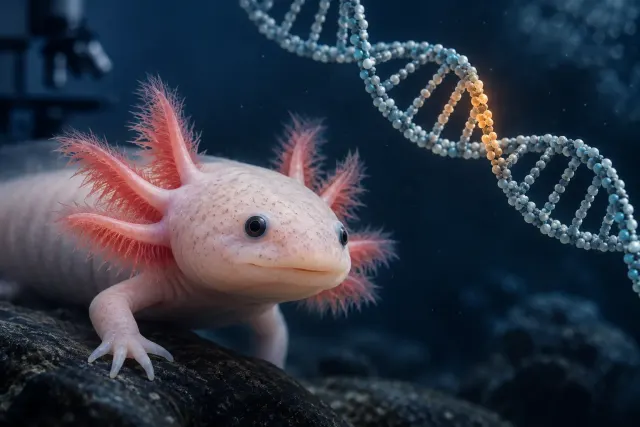
In 2018, researchers fully sequenced the axolotl genome for the first time — and it turned out to be enormous. At around 32 billion base pairs, it’s roughly ten times the size of the human genome, and was, at the time, the largest animal genome ever sequenced. A genome that large is technically difficult to work with, but having it mapped has opened the door to understanding exactly which genes switch on during regeneration, something that was largely guesswork before.
Why Axolotls Almost Never Get Cancer
Regeneration requires cells to rapidly divide and partially “de-specialise” — which, in most animals, is exactly the kind of cellular behaviour that can trigger cancer. Axolotls somehow do this constantly, on demand, without it running away into tumour growth. Researchers studying axolotl cancer resistance are trying to understand the safety mechanisms axolotl cells use to keep rapid regeneration under tight control — with an eye toward what that might teach us about cancer suppression more broadly.
CRISPR and the Rise of the Axolotl as a Lab Model
Gene-editing tools like CRISPR let researchers switch specific genes on or off and observe what happens — and axolotls have become an increasingly common subject for exactly this kind of work. By disabling specific genes thought to be involved in regeneration and watching whether a blastema still forms correctly, scientists are slowly building a map of which genes are actually essential to the process, rather than just correlated with it.
What We’ll Cover Next
This roundup format will keep going as new axolotl research becomes publicly available — new regeneration findings, conservation survey updates, and anything else genuinely newsworthy in axolotl science. If you want the biology fundamentals behind all of this first, start with Why Axolotls Can Regrow Limbs.
Frequently Asked Questions
Why is the axolotl genome so much bigger than the human genome?
Much of it is made up of repetitive genetic sequences that don’t code for proteins. Scientists are still working out exactly why regenerating species tend to carry so much extra genetic material.
Do axolotls get cancer at all?
Rarely, compared to most vertebrates, though it isn’t literally impossible. That relative resistance is exactly what makes them useful for cancer research.
Is CRISPR gene-editing used on pet axolotls?
No — this research happens in dedicated lab colonies bred specifically for research, entirely separate from the pet and breeder population.