Neoteny Explained: Why Axolotls Never Grow Up
Most salamanders start life in the water with external gills, then metamorphose into a land-capable adult — losing the gills, changing their skin, and developing the ability to survive out of water. Axolotls are one of the few salamanders that, left to their own devices, simply never do this. They reach full sexual maturity and live out their entire adult life in the same gilled, aquatic body they hatched with. That trait has a name: neoteny.
Quick answer
Neoteny means axolotls reach sexual maturity while keeping their larval body — external gills, tail fin, fully aquatic life — instead of metamorphosing into a land-dwelling salamander like their close relatives. It is driven by low thyroid-hormone signalling and suits their cool, stable native lake. Forced metamorphosis is possible but harmful and should never be attempted at home.
- Axolotls are neotenic for life under normal conditions
- Closest relatives (tiger salamanders) do metamorphose
- Metamorphosis can be triggered by thyroid hormone — dangerous, shortens lifespan
- Neoteny is thought to be an adaptation to a stable aquatic habitat
What Neoteny Means
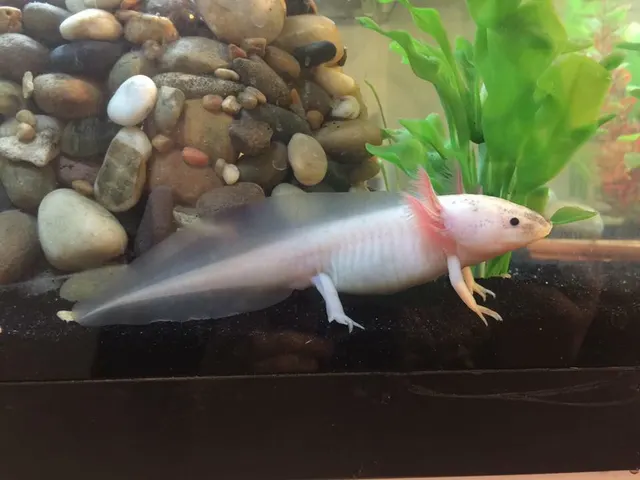
Neoteny (sometimes called paedomorphosis) is the retention of juvenile physical traits into adulthood. In the axolotl’s case, that means keeping external feathery gills, a fin running along the tail, and an aquatic lifestyle for its entire life, rather than these being a temporary larval stage. It’s not that axolotls are perpetually “young” biologically — they mature, breed, and age normally — they simply never undergo the physical transformation most other salamanders go through.
The Thyroid Connection
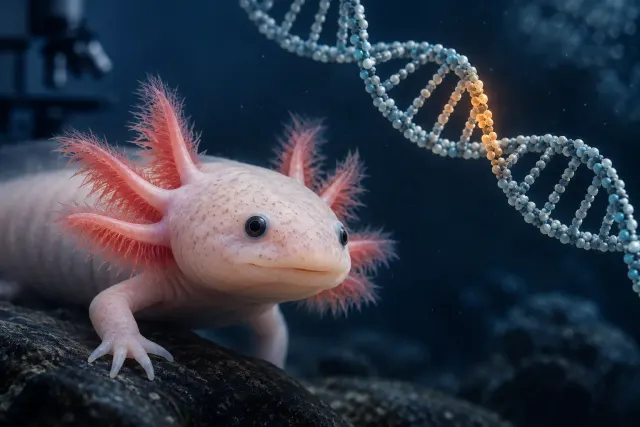
In amphibians, metamorphosis is normally triggered by a surge in thyroid hormone activity. In most salamander species, that hormonal signal kicks off the changes that turn a gilled larva into a land-ready adult. Axolotls have a disrupted relationship with that signal — their tissues largely don’t respond to it the way other salamanders’ do, so the transformation simply never gets triggered under normal conditions. This is well enough understood that axolotls can sometimes be induced to metamorphose artificially, using iodine or thyroid hormone treatments — though this isn’t something reputable keepers do, for reasons below.
When Axolotls Do Metamorphose
It’s rare, but not unheard of, for an axolotl to metamorphose naturally, and it can also be triggered deliberately with hormone treatment. When it happens, the axolotl loses its external gills and fin, its skin thickens and changes texture, and it becomes capable of leaving the water — essentially becoming a fully terrestrial tiger salamander relative. It sounds dramatic, but it’s generally considered harmful rather than a fun party trick: metamorphosed axolotls tend to have significantly shortened lifespans and increased health complications, and the process itself is stressful. It isn’t something to attempt with a pet axolotl.
Why This Matters for Axolotl Owners
Neoteny isn’t just a fun biology fact — it’s the reason axolotl care looks the way it does. Because they never leave the water, everything about their care revolves around getting the aquatic environment right: stable cool temperatures, a fully cycled tank, and careful water quality management, since (unlike a metamorphosed land salamander) an axolotl can’t just leave the water if conditions turn bad. See Setting Up Your Axolotl Tank and How to Cycle an Axolotl Aquarium for the practical side of what this biology demands.
Frequently Asked Questions
Is neoteny unique to axolotls?
No — a handful of other salamander species and populations show neoteny too, but axolotls are by far the best known and most studied example.
Should I try to make my axolotl metamorphose?
No. It’s stressful, risky, and tends to shorten the animal’s lifespan. A healthy aquatic axolotl in proper conditions is the goal, not metamorphosis.
Does neoteny mean axolotls stay small forever?
No — they still grow to full adult size (typically 8–12 inches) and reach sexual maturity. Neoteny is about retaining the aquatic, gilled body plan, not about staying physically small.