Why Axolotls Can Regrow Limbs (and Why Humans Can't — Yet)
Cut the tip off an axolotl’s tail, and within a few weeks it will grow back — same bone, same muscle, same skin, no scar. Lose an entire leg, and the same thing happens: a new one forms, fully functional, indistinguishable from the original. It’s one of the reasons axolotls have become such a fixture in biology labs, and it’s worth understanding what’s actually going on, since “they just regrow it” undersells one of the strangest tricks in vertebrate biology.
Quick answer
Axolotls regrow limbs because cells at the wound site temporarily revert to a stem-cell-like state, form a growth mass called a blastema, and rebuild bone, muscle, nerve and skin in the correct pattern — a program mammals switch off after embryonic development. It takes weeks, costs energy, and works throughout the animal's life.
- Can regenerate limbs, tail, jaw, parts of the spinal cord, heart and brain
- A blastema forms within days; a full limb takes roughly 4–8 weeks in a juvenile, longer in adults
- The regrown limb is correctly sized and patterned, with no scar
- Humans regrow fingertips in early childhood only — the same program, switched off
What “Regeneration” Actually Means
Plenty of animals can heal wounds. Very few can regrow entire, complex body parts — bone, muscle, nerve, blood vessel, and skin, all correctly patterned and correctly sized. Axolotls can do this with limbs, tails, jaws, portions of the spinal cord, and parts of the heart and brain. Unlike a healed human wound, which patches the damage with scar tissue, an axolotl’s regenerated limb is original-quality tissue — not a functional patch, but a rebuild.
The Blastema: Nature’s Rebuild Kit
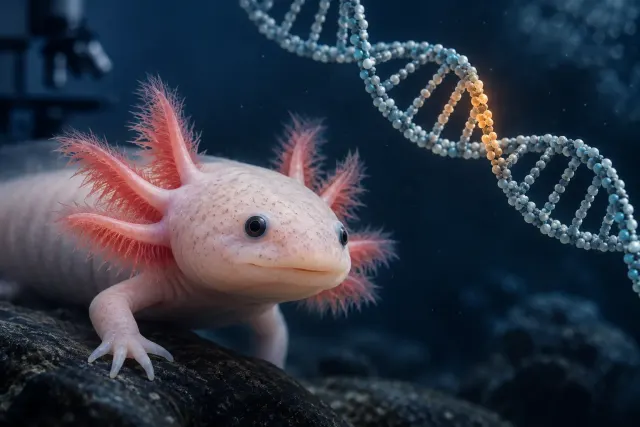
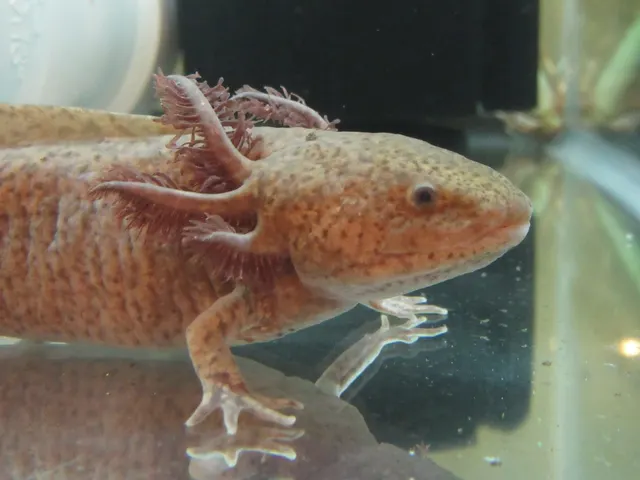
The process starts with a structure called a blastema — a small mass of cells that forms at the site of the injury within days. Nearby mature cells (skin, muscle, bone) partially “de-specialise,” migrate to the wound site, and begin dividing rapidly. Those cells then re-specialise into exactly the tissue types needed, in exactly the right positions, to rebuild the missing structure from the point of amputation outward. It’s a bit like the limb remembers what it’s supposed to look like and rebuilds itself piece by piece to match.
This is also why the process takes weeks rather than being an instant transformation — a blastema has to form, grow, and gradually redifferentiate into bone, cartilage, muscle, nerves, and skin in the correct arrangement. It’s real, resource-intensive biology, not a shortcut.
Not Just Limbs
Limb regrowth gets the most attention, but axolotls also regenerate:
- Tail tissue, including spinal cord segments
- Portions of the heart, without the permanent scarring that follows a human heart injury
- Parts of the brain and jaw
- Skin, without scar formation — even large wounds tend to heal scar-free
Why Humans Can’t Do This (Yet)
Human cells have some regenerative ability — liver tissue regrows, and bone can heal — but we can’t rebuild an entire limb or scar-free skin the way axolotls do. Part of the reason seems to be that mammalian wound healing prioritises speed: we seal wounds fast with scar tissue (mostly collagen) to prevent infection and blood loss, which is a great short-term survival strategy but blocks the kind of controlled regrowth axolotls achieve. Axolotls also seem to retain a much greater ability to reactivate developmental programs in adult tissue — essentially re-running parts of the genetic instructions used to build the limb the first time around, as an adult.
What Human Medicine Is Learning
This is exactly why axolotls are one of the most studied model organisms in regenerative medicine. Researchers study blastema formation to understand what triggers cells to de-specialise safely (without triggering cancer, which is a major concern in humans), how scar-free wound healing works, and how nerve tissue can be coaxed to regrow. None of this means human limb regeneration is around the corner — but the underlying biology is directly relevant to wound healing, scar reduction, and tissue engineering research today.
Frequently Asked Questions
How long does it take an axolotl to regrow a limb?
It varies with the animal’s age, health, and water temperature, but a full limb regrowth typically takes several weeks to a few months — faster in younger axolotls, slower in older ones.
Can an axolotl regrow the same limb more than once?
Yes. Unlike many animals with limited regenerative ability, axolotls can regenerate the same structure repeatedly throughout their life.
Does regenerating a limb hurt the axolotl or shorten its life?
Regeneration is a natural, energy-intensive process, but a healthy axolotl in good water conditions typically recovers well. See our Axolotl Illness and Treatment guide for how to support an injured axolotl’s recovery.
Why are axolotls used in science labs specifically, and not other salamanders?
Axolotls combine strong regenerative ability with being easy to breed and raise in captivity, plus a fully sequenced genome — a practical combination that’s hard to find in other regenerating species.