Chimera Axolotl: The Two-Coloured Axolotl
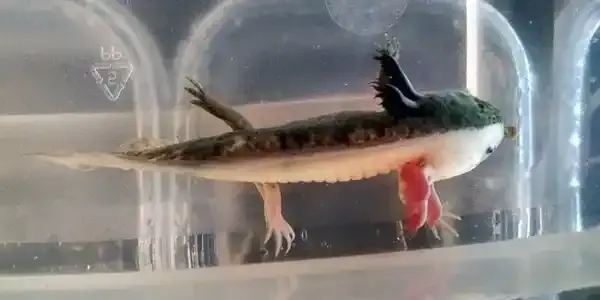
A chimera is the split-faced axolotl: one side of the body one colour, the other side another, divided along the middle as if drawn with a ruler.
Quick answer
In the hobby, a chimera axolotl is one whose left and right sides are different morphs, such as leucistic on one side and wild type on the other. The usual explanation is that two embryos fused very early in development and each built part of the body. It is a chance event, and the split look is not inherited.
- Different morph on each side of the body
- Explained by two embryos fusing early
- The look is not inherited
- Named by appearance; the cause cannot be confirmed by eye
What a chimera axolotl looks like
The classic chimera has a clean line down the centre of the head and back, with different skin colour, eye colour and gill colour on each side. The split is not always perfect, and it may wander or fade toward the tail. If both embryos were the same morph, the animal is still a chimera but nobody would know by looking.
How a chimera forms
A true chimera contains cells from two different fertilised eggs: two very early embryos merge and carry on developing as one. When the cells from each tend to build one side of the body, the result is the split look. A mosaic, by contrast, has two cell populations that arose within a single egg. The two cannot be told apart by eye, which is why keepers name them by pattern. Because the look comes from how the embryo formed and not from a morph gene, it is not passed on: a chimera’s offspring inherit from whichever cells formed its eggs or sperm and normally look like standard morphs.
How to tell a chimera from similar axolotls
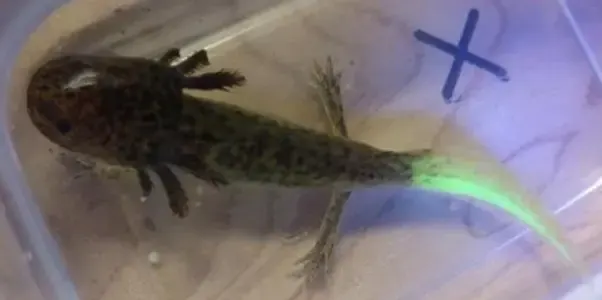
A mosaic has scattered patches with no left-right division. The firefly was made deliberately by grafting, and its division is between the front and the tail, not the left and right.
Care and buying notes
Some keepers report one half of a chimera growing a little slower than the other. Watch that the animal swims and feeds normally. Water and feeding needs are the same as for any axolotl: see our Axolotl Care Sheet.
Frequently Asked Questions
How rare is a chimera axolotl?
Extremely rare. Chimeras arise by chance and most breeders never produce one.
Can chimera axolotls have chimera babies?
The split pattern is not inherited. A chimera may breed, and its babies normally look like standard morphs.
What is the difference between a chimera and a mosaic axolotl?
Keepers call an axolotl a chimera when it is divided down the middle and a mosaic when the two colours are scattered in patches.