General Axolotl Information
The axolotl (Ambystoma mexicanum) is one of the most unusual amphibians on the planet — a salamander that never quite grows up, and one of the very few vertebrates capable of regenerating lost body parts. This page covers the background behind the species; for hands-on care, see our Axolotl Care Sheet and What Are Axolotls?.
Origin and Habitat
Axolotls are native to a single, shrinking network of freshwater lakes and canals in the Valley of Mexico, historically centred on Lake Xochimilco (and, before it was drained in the 20th century, the neighbouring Lake Chalco), just south of Mexico City. In the wild, they live in cool, weedy waterways rather than open water — hiding among aquatic vegetation and sediment.
The name “axolotl” comes from Nahuatl, the language of the Aztecs, and is often translated as “water dog” or linked to Xolotl, the Aztec god of fire, lightning, and death — who, according to legend, transformed himself into a salamander to escape sacrifice.
Taxonomy
Axolotls belong to the order Urodela (Caudata), the salamanders, and the family Ambystomatidae — the mole salamanders. Despite the common nickname “Mexican walking fish,” an axolotl is not a fish at all; it’s an amphibian, closely related to the tiger salamander.
Conservation Status
Axolotls are listed as Critically Endangered on the IUCN Red List. Wild population surveys in Xochimilco have recorded a dramatic, decades-long decline, driven by:
- Urban expansion and pollution of the canal system
- Introduced species, particularly tilapia and carp, which prey on axolotl eggs and young and compete for food
- Loss and degradation of the remaining wetland habitat
It’s a striking contradiction: axolotls are teetering on the edge of extinction in the wild, while thriving by the thousands in home aquariums, universities, and research labs around the world. Conservation groups in Mexico continue to work on restoring canal habitat and establishing protected refuges within Xochimilco.
Neoteny: The Salamander That Never Grows Up
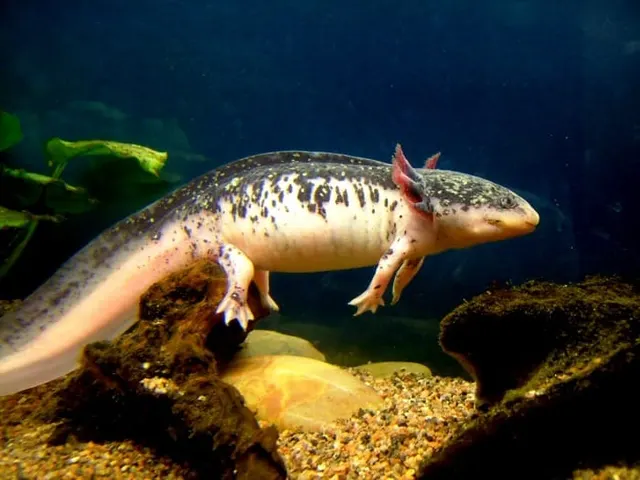
Most salamanders hatch into an aquatic larval stage, then metamorphose into a land-dwelling adult. Axolotls are famous for skipping that step entirely — a trait called neoteny (or paedomorphosis). They reach full sexual maturity while still in their larval, fully aquatic form, keeping their feathery external gills and tail fin for life instead of developing lungs and losing their gills.
Metamorphosis isn’t impossible — it can occasionally happen naturally, or be triggered in captivity with iodine or thyroid hormone — but it’s stressful, shortens the axolotl’s lifespan, and isn’t something keepers should attempt. It’s part of why axolotls need cooler water and gentle care rather than the setup of a typical land-and-water amphibian tank.
Regeneration
Axolotls are one of the only vertebrates capable of fully regenerating entire limbs, portions of the spinal cord, and even parts of the heart and brain — usually without scarring. This ability has made them one of the most heavily studied animals in regenerative medicine, with researchers around the world working to understand how axolotl cells manage to rebuild complex tissue that most animals, including humans, cannot.
Quick Facts
| Scientific name | Ambystoma mexicanum |
| Conservation status | Critically Endangered (IUCN) |
| Native range | Lake Xochimilco, Mexico City |
| Lifespan | Typically 10–15 years in captivity |
| Diet | Carnivorous |
| Notable traits | Neoteny, limb and organ regeneration |
Curious what colour variations exist? See our full guide to axolotl morphs and colour.