Frequently Asked Questions (FAQ)
Here are the questions we receive most frequently.
How big do axolotls grow?
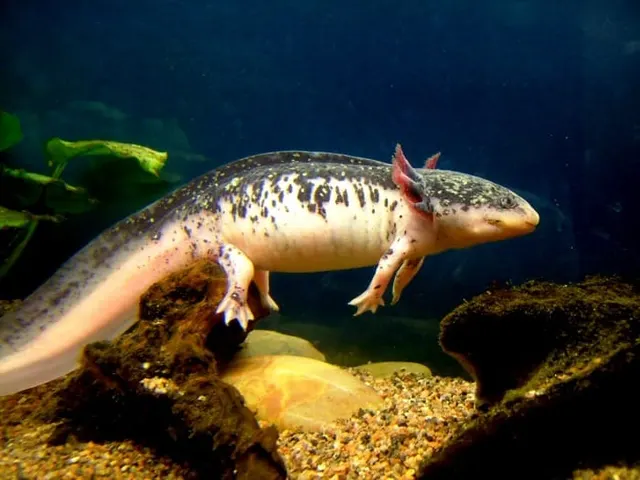
Most axolotls will generally grow to around 8 inches in length. It’s not unheard of for one to reach 12 inches.
How long do axolotls live?
Axolotls can live up to 15 years. In captivity, though, they’re more commonly seen living 8–10 years on average when cared for properly.
What are GFP axolotls?
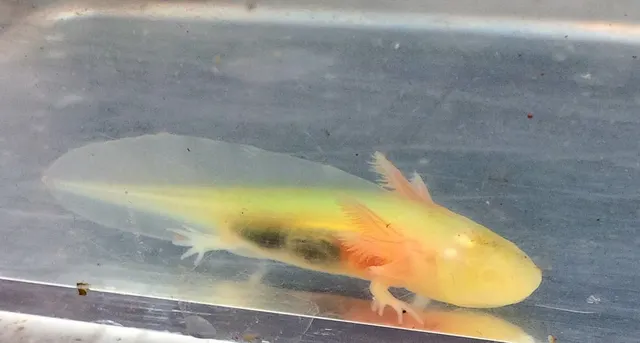
Green Fluorescent Protein (GFP) axolotls are axolotls that have an ancestor, somewhere down the line, with a genetically modified lineage — a modification that combined axolotl DNA with jellyfish DNA. It’s not something that occurs naturally; its original purpose was to aid cancer research. Axolotls with this genetic trait glow vibrant green under black or UV light.
What do axolotls eat?
Check out our page on food for axolotls.
How big should my tank be?
Aim for around 10 gallons per adult axolotl. This can flex a little depending on the aquarium’s surface area. If you’re housing juveniles, it’s recommended to have 1 gallon for every inch of your axolotl’s length.
Can I keep more than one axolotl?
Yes, of course — it’s recommended to allow 10 gallons for every additional adult axolotl you keep together.
Does my tank need to be cycled?
Yes — it doesn’t matter what aquatic life you’re keeping, cycling your tank first ensures a suitable, stable environment.
Do I need a filter?
Axolotls don’t need a filter to breathe, since they’re amphibians. That said, a filter is highly recommended to sustain a stable cycle. Cycling your tank without one is possible, but not recommended.
Can I take my axolotl out of the tank and pet it?
😰 Please, just don’t. Axolotls are entirely aquatic and have a delicate protective slime coat — time out of water is stressful and handling can damage their skin.
Is my axolotl a male or female?
Check out our page on gender and sexual maturity.
What do I need to set up my tank?
We get this question so often that we built an entire page on it — see setting up your axolotl tank.
Can axolotls really regrow lost limbs?
Yes — this is one of their most famous traits. Axolotls can regenerate not just limbs, but also parts of their spinal cord, heart, and even brain tissue, often with no scarring at all. It’s why they’re such a major focus of regenerative medicine research.
Is it legal to own an axolotl?
It depends entirely on where you live. Axolotls are restricted or banned in some jurisdictions (for example, a handful of U.S. states) due to concerns about their release into local waterways. Always check your local and regional wildlife regulations before bringing one home.
Can axolotls live with fish or other tank mates?
Generally, no. Most fish either nip at an axolotl’s feathery gills or end up as an easy snack, and many carry parasites axolotls aren’t equipped to handle. Axolotls are best kept alone, or with other axolotls of a similar size.
Why won't my axolotl eat?
A temporary loss of appetite is common and often linked to stress (a recent move or tank change), water quality issues, water that’s too warm, or the approach of a seasonal breeding cycle. If it persists for more than a week or two, or comes with other symptoms, it’s worth testing your water and consulting our illness and treatment guide.
Do axolotls need special lighting?
No — in fact, it’s the opposite. Axolotls don’t have eyelids and are sensitive to bright light, so dim or indirect lighting is best. Unlike reptiles, they don’t need UVB lighting at all.